

Ear Syringing vs Irrigation vs Microsuction: Which Is Best for You?
If your ears feel blocked and you've started searching for "ear syringing near me", you'll have noticed the words syringing, irrigation and microsuction being used as if they mean the same thing. They don't. At Littleborough Ear Care we see people every week from Littleborough, Rochdale, Milnrow, Todmorden and Wardle who have been told different things by different people. Here's a plain explanation of each method, what the NHS guidance says, and how to choose.
What is ear syringing?
Ear syringing is the old method many people remember from their GP surgery. A large metal syringe was used to push water into the ear canal by hand to flush the wax out. The problem was that the pressure depended entirely on how hard the person pressed the plunger.
That's why the guidance changed. NICE, which sets clinical guidelines for the NHS in England, now says practitioners should not offer adults manual syringing to remove earwax. If someone offers you "syringing" today, it's worth asking what they actually mean, because most clinics now use the word loosely to describe modern irrigation. You can read more on our ear syringing page.
What is ear irrigation?
Irrigation is the modern replacement for syringing. Instead of a hand-pressed syringe, a machine delivers a steady stream of body-temperature water at a controlled pressure, which loosens the wax and washes it out. NICE lists irrigation with an electronic irrigator as one of the recommended methods, alongside microsuction, when it's carried out by a trained practitioner with the right equipment.
Irrigation works well for soft wax, or wax that has been softened with drops beforehand. It isn't suitable for everyone, and it's usually avoided if you have:
a perforated eardrum, now or in the past
grommets, or recent ear surgery
a current ear infection
only one hearing ear
What is microsuction?
Microsuction uses a fine, gentle suction tube to lift the wax out while the practitioner looks directly into your ear canal under magnification. Everything happens under direct vision and no water is involved, so the wax is removed in a very controlled way. You'll hear a hissing or crackling sound during treatment, but it shouldn't hurt.
Microsuction is often the better choice for hard or impacted wax, for people who can't have water in their ears, and for anyone who wants the wax cleared in a single visit. Our post How does microsuction work? goes into more detail, or see our microsuction ear wax removal page.
Syringing vs irrigation vs microsuction at a glance
Ear syringing: hand-pressed syringe with uncontrolled pressure. NICE says it shouldn't be offered to adults, and we don't offer it.
Irrigation: machine-controlled warm water. Good for soft or pre-softened wax. Not suitable if you have a perforation, grommets or an infection.
Microsuction: gentle suction under magnification with no water. Good for hard, impacted or stubborn wax, and for people who can't have irrigation.
Which method is right for you?
You don't need to decide before you arrive. At your appointment, Stuart White, a fully trained, insured and qualified audiologist with five years' ear wax removal experience, will examine your ears, ask about your ear history and recommend the method that is safest for you. Sometimes that's microsuction, sometimes irrigation, and occasionally a combination of the two.
The things that help us decide are how hard the wax is, whether you've used drops beforehand, any history of ear problems, and whether you wear hearing aids or use earbuds a lot.
Should you use ear drops first?
The NHS advises that a few drops of olive or almond oil can help soften earwax, and that you shouldn't use drops if you have a perforated eardrum (NHS: earwax build-up). Softened wax is easier to remove with either method. Our guide on how to prepare for ear wax removal explains what to do in the days before your appointment.
What you should never do is reach for cotton buds, ear candles or a DIY camera kit. They tend to push wax deeper and can damage the ear canal. We explain why in The Dangers of DIY Ear Wax Removal.
Ear wax removal in Littleborough, Rochdale and nearby
Our clinic is in Littleborough, an easy trip from Rochdale, Milnrow, Wardle, Todmorden, Walsden and Whitworth. Not all GP surgeries remove earwax any more, so many of our patients come to us after being told to go private.
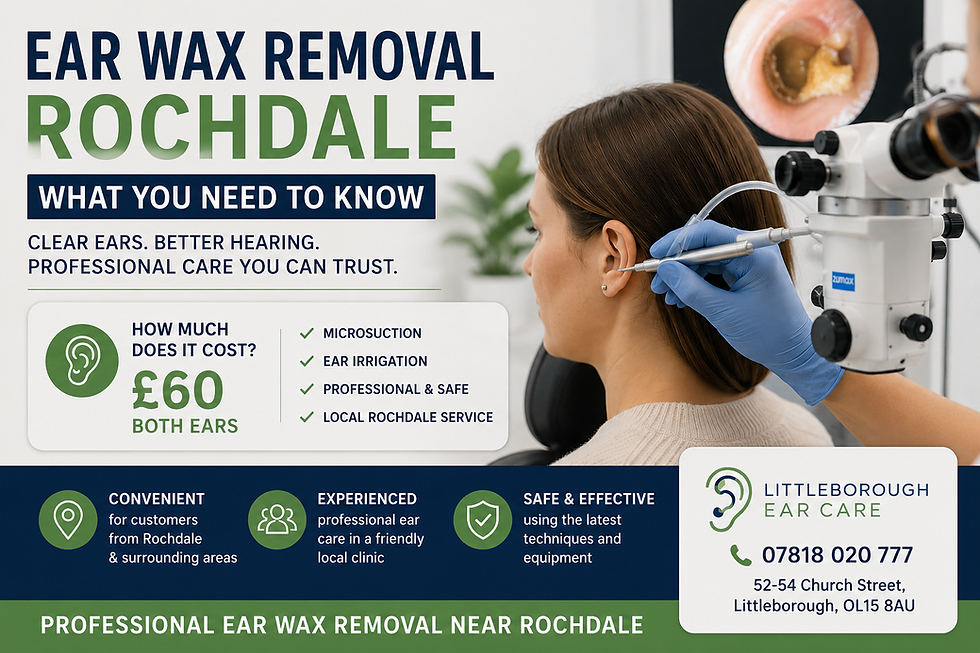
Microsuction and irrigation both cost £60 at Littleborough Ear Care. You can see how that compares in our post on how much professional ear wax removal costs.
Ready to hear clearly again? Book your ear wax removal appointment online, or get in touch if you'd like to ask a question first.
This article is general information, not a diagnosis. If you have sudden hearing loss, severe pain, discharge from your ear or dizziness, contact your GP or NHS 111.



Comments